Fast, practical answers for choosing the right artificial Christmas tree, understanding today’s LED lighting, assembling and shaping it correctly, solving common light problems, and storing it well for next season.
Practical answers about height, width, branch clearance, ornament strength, and the construction details that matter once your tree is assembled and decorated.

Artificial Christmas tree height is measured from the floor to the tallest tip of the fully assembled tree, including the stand. Width is the tree’s diameter at the widest point after the branches are shaped, measured from one branch tip to the opposite branch tip.
If you are still comparing room fit, browse the full artificial Christmas tree collection and review the buyer’s guide.
Yes. Artificial Christmas tree width varies by height, silhouette, branch style, and how carefully the tree is shaped. A slim tree, full tree, tabletop tree, and potted tree can all feel very different in the same room even if the heights are similar.
Many shoppers start on the all trees page and then narrow by PE realism or traditional PVC.
Depending on how the tree is shaped, the bottom row is generally about 7" to 12" from the floor. Final clearance can vary slightly based on tree style and shaping.
All Treetime trees have branches reinforced with steel and are suitable for heavy ornaments. For best presentation, hang heavier decorations farther back on the branch where support is strongest.
If heavy decorating is part of your plan, the buyer’s guide and ornament category are both helpful.
The hinges on our trees are made of lightweight steel, designed for strength, repeated seasonal setup, and dependable support over time.
Understand tip count, Real-Needle Technology™, PE vs. PVC needles, flame-retardant materials, fullness, and what affects long-term tree durability.

Tip count refers to the terminating tip of every branch. Some styles use forked or multiple tips, which creates a higher count. Other trees may have fewer tips but larger ones, so they can still look very full.
Real-Needle Technology™ refers to molded, three-dimensional PE branch tips designed to look more like natural evergreen foliage. These realistic tips are often combined with PVC greenery inside the tree to add fullness and depth.
If realism is your priority, start with the Most Realistic PE collection.
Treetime states that its artificial Christmas trees use flame-retardant materials. Flame-retardant does not mean fireproof, so keep the tree away from open flame, high heat, and damaged electrical components, and always follow the product’s lighting and placement instructions.
Most artificial Christmas trees are made with PVC, PE, or a mix of both materials. Treetime trees also use reinforced branch construction and a sturdy base designed for repeated seasonal setup, shaping, decorating, and storage.
With proper shaping, storage, and care, a high-quality artificial Christmas tree can last for many holiday seasons. Careful off-season storage helps preserve the branch shape and lighting system.
See tree storage options and the warranty page for more long-term support.
PVC needles are usually thinner, flatter, and flexible, which helps create fullness. PE needles are molded into more realistic three-dimensional branch tips. Many premium artificial Christmas trees combine PE on the outer branch tips with PVC inside for a balance of realism, density, and value.
Compare incandescent, standard LED, Micro LED, ColorChange™, and app-controlled lighting, plus replaceable-bulb expectations, timers, color choices, and what to do when a section goes dark.

No. Many Treetime pre-lit Christmas trees are available with LED lights, while some styles are offered with traditional incandescent mini lights. Unlit trees are also available for shoppers who prefer to add their own lights.
You can compare LED, incandescent, and unlit collections directly.
We offer a range of lighting options including warm white, clear, multi-color, LED color-change, and unlit styles depending on the collection.
It depends on the lighting system. Traditional incandescent mini-light sets may use replaceable bulbs, while some LED, sealed-bulb, ColorChange™, or controller-based systems are serviced differently.
Use the replacement method specified for your model. For lighting problems, start with the Christmas light troubleshooting guide; if the system uses sealed LEDs or a controller, contact Treetime before taking the light set apart.
Clear lights create a classic, elegant glow, while multi-colored lights deliver a brighter, more festive look. The right choice depends on the atmosphere you want in your room.
Dual-function or color-change lighting lets you switch between clear and multi-colored lighting on the same tree without changing your setup.
The answer depends on the light technology. Many incandescent mini-light systems are designed so one burned-out filament does not immediately darken the entire strand, but a loose, missing, or damaged bulb can still interrupt a series. LED and controller-based systems behave differently by model.
If a section goes dark, begin with power and section connections, then follow the light repair guide for the type of lights on your tree.
Pre-lit artificial Christmas trees are usually better for convenience, faster setup, and evenly spaced lighting. Separate lights are better if you want full control over bulb style, spacing, color, or future changes. If you prefer decorating completely from scratch, the unlit collection may be a better fit.
LED lights generally use much less electricity, stay cooler to the touch, and have a longer service life than traditional incandescent lights. Incandescent mini lights are valued for their familiar warm glow and straightforward replaceable-bulb design on compatible sets.
Modern warm-white LEDs can now produce a much more traditional-looking glow than early LEDs. Compare LED trees, incandescent options, and the exact lighting system listed on each product page.
Micro LEDs use very small bulbs—often described as rice-sized—to create a finer, more integrated sparkle within the foliage. Their smaller scale can make the light points feel less visually bulky and more like a soft firefly shimmer.
Micro LED availability varies by tree model, so check the light type and light count in the product specifications rather than assuming every LED tree uses the same bulb style.
Treetime’s LED ColorChange™ systems are designed to switch between multiple lighting moods—such as warm white, pastel, and multicolor—with model-dependent effects such as twinkle.
RGB or app-controlled lighting goes further by using red, green, and blue LEDs to create a much wider range of colors and programmable effects on select models. Remote functions, apps, dimming, music modes, and available effects vary by product, so use the specifications for the exact tree you are considering.
A properly rated timer can be convenient, but controller-based LED, ColorChange™, or RGB systems may have model-specific requirements and may not resume the same effect after power is cut. Use only accessories that are compatible with the tree’s electrical requirements.
Never bypass the original adapter or controller. If your tree uses special lighting electronics, follow the model instructions or ask Customer Service before adding a smart plug or dimmer.
Help with first setup, section order, Power Pole connections, shaping for fullness, safe assembly habits, and storing your artificial Christmas tree after the season.
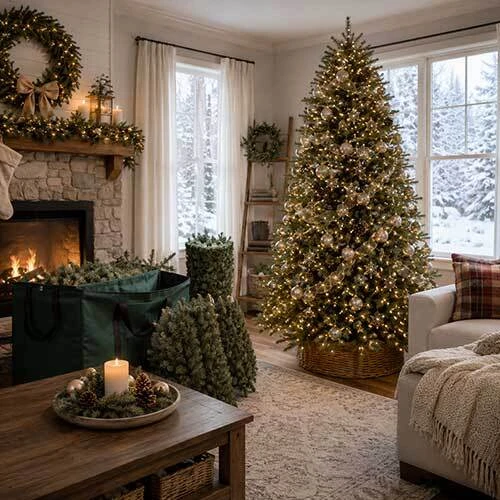
Yes. Treetime artificial Christmas trees are designed for straightforward assembly and usually arrive in manageable sections. Many styles use hinged branches, so setup is mostly a matter of placing each section in order, connecting the lights if needed, and shaping the branches.
For a full walkthrough, go to the assembly guide.
Choose a location near a wall outlet, remove all parts from the box, and arrange them so they are easy to access. Before you begin, inspect the tree and cords for any cut, damaged, or frayed wiring.
Smaller trees generally use fewer sections and larger trees use more. In general, trees around 5 feet and under may have one to two sections, mid-sized trees often have three, and taller trees may use four or more sections.
Start with the bottom section first, then work upward. The base section is typically the only one with a tapered or pointed pole end and often has the longest electrical cord.
For the fullest look, shape one section and one row at a time. Fan each branch tip outward, upward, and slightly to the side so the foliage fills gaps around the center pole. Shaping matters most the first time the tree is set up after shipping.
You can also use the resource center for visual help.
Remove decorations, unplug the tree, and take it apart section by section. Compress branches gently rather than crushing them, keep cords and hardware protected, and store the tree in a clean, dry location away from moisture, extreme heat, pests, and heavy objects.
Read the full artificial Christmas tree storage guide. If you need a bag, jump directly to the Storage Bag Finder to match supported Treetime trees and heights with recommended bags.
Yes. The resource center includes tower tree assembly help, and Treetime also offers a dedicated tower tree shopping category.
Yes. Shape the bottom section while it is easy to reach, then add the next section and repeat. Working section by section gives you better access to the inner branches and usually produces a fuller, more natural result than assembling the entire tree first.
The assembly and shaping guide shows the complete base-up sequence.
Artificial trees are compressed for shipping and storage, so the branches can look flat, narrow, or uneven when first opened. That is normal. Give the branches time to drop, then shape from the center pole outward and fan individual tips in different directions before judging the finished fullness.
First-season shaping usually takes the most work; once the branch structure has been opened and trained, future setup is typically easier.
There is no single correct time. First setup usually takes the longest because the tree was tightly compressed for shipping. Taller, denser trees naturally require more shaping than slim, open, or sparse trees.
The better benchmark is coverage: work one branch level at a time from the center pole outward until gaps are filled and the silhouette looks balanced. Do not rush or flatten branches just to finish faster.
On Treetime models equipped with EZ-UP Power Pole technology, the electrical connection is carried through the center pole as the tree sections are stacked, reducing the number of light cords you need to connect manually inside the tree.
Not every tree uses the same connection system. For traditional section wiring, short lighting cords connect within the tree, while long extension-style cords should run down the pole to the wall or a properly rated power strip. Do not daisy-chain long cords inside the tree.
No. Treetime’s assembly guidance recommends keeping the tree upright in the stand while adding sections. Tipping an assembled tree can put unnecessary leverage on the center pole and may bend or stress it.
For taller trees, use an appropriate step stool or ladder and a second person when needed rather than leaning the tree.
Choose with confidence by comparing room size, topper clearance, shape, fullness, foliage, lighting, construction, decorating style, and outdoor-use requirements.

Measure your ceiling height first, then choose a tree that leaves enough clearance for a topper and comfortable visual proportion in the room. Width matters just as much as height, especially in smaller rooms, corners, apartments, offices, and entryways.
Browse the full tree collection and review the buyer’s guide if you want help narrowing things down.
As a useful starting point, leave about 6 to 12 inches between the top of the finished tree and the ceiling, depending on the height of your topper. Also compare the tree’s listed width with furniture, doors, stair rails, fireplaces, and walkways.
For many rooms with an 8-foot ceiling, a 7- to 7.5-foot tree is a comfortable fit. Use the buyer’s guide or Tree Finder to narrow the options.
Yes. Strong center poles and stands matter more once the tree is fully decorated. Better structure improves stability, durability, and confidence when using heavier ornaments.
Hinged branches are generally faster and easier to set up because they stay attached to the center pole. You simply let them down, shape the foliage, and continue assembly.
PE adds realism, PVC adds fullness, and mixed foliage often gives a strong balance of lifelike appearance, fullness, and value.
Match your decorating style to the tree’s shape, strength, and lighting. If you plan to use heavier ornaments, branch strength matters more.
You can also shop ornaments and ribbons & bows.
Look for lights that feel balanced and even rather than sparse, are securely attached, and are designed with burn-out protection so one failure does not darken the entire display.
Shape describes the overall footprint—such as full, wide, slim, potted, or tabletop. Fullness describes how much branch density and open space you see within that shape.
Treetime organizes fullness into Dense, Layered, Open, and Sparse profiles so you can choose the visual character separately from the tree’s height and width.
Choose Dense for the fullest traditional look with minimal open space; Layered for balanced fullness with visible depth; Open for an airier natural silhouette and more visible ornament placement; or Sparse for the most negative space and a more sculptural, curated look.
There is no universally better fullness. The right choice depends on whether you want the greenery itself to feel lush or you want ornaments, ribbon, and branch structure to have more breathing room.
Yes. Use the Artificial Christmas Tree Finder. It narrows the collection by fullness first, then height, and then lighting preference so you can eliminate obviously wrong fits before comparing individual families.
For deeper comparisons of foliage, construction, lighting, and room scale, use the Buyer’s Guide.
No. Do not assume a tree is outdoor-rated just because it is artificial. Unless the individual product page specifically says the tree is approved for outdoor or semi-covered use, keep it indoors.
Moisture, direct weather, prolonged sunlight, and outdoor electrical conditions can damage foliage, finishes, wiring, and structural components. Commercial outdoor-rated products and select specialty trees are designed differently.
A safer troubleshooting path for dark sections, loose bulbs, blown fuses, bad contacts, and the important differences between incandescent and LED repair methods.

If your Christmas lights are not working, start with power, the plug fuse, loose bulbs, twisted bulbs, broken bulb wires, and any bulbs that are not fully seated in their sockets. These simple checks solve many light outages before deeper troubleshooting is needed.
On traditional incandescent mini-light sets, bulbs are part of an electrical series. A loose, missing, broken, or poorly seated bulb can interrupt that path and affect the rest of the series. LED and sealed-light systems are built differently, so incandescent bulb-by-bulb repair methods should not automatically be used on them.
The Leapfrog technique is Treetime’s step-by-step method for isolating a bad bulb or socket contact on traditional incandescent mini-light sets with removable bulbs. It uses a verified working replacement bulb and moves through the affected series methodically.
Do not use the method on sealed LEDs or ColorChange™ systems unless the model instructions specifically call for that type of bulb service.
If the quick checks and repeatable process do not solve the issue, the problem may be more complex than a simple bulb replacement. At that point, review the troubleshooting guide, warranty support, or customer care.
If the strand has suffered a cascading outage and the bulbs across that section have burned out under strain, replacing all bulbs in the affected strand may be the most practical fix.
Usually not. Treetime’s Leapfrog and re-bulbing methods are intended for traditional incandescent mini-light sets with removable bulbs. For LED, sealed-bulb, ColorChange™, or RGB systems, begin with the outlet, power switch, original adapter or controller, and section connections.
If those checks do not solve the problem, follow the model instructions or contact Treetime Customer Service before disassembling the lighting system.
Use these resources when a visual walkthrough is more helpful than a written answer for shaping, setup, storage, decorating, wreaths, garland, or tower trees.

The How-to Christmas Resource Center is the best place to watch Treetime videos for shaping an artificial Christmas tree, assembling sections, storing your tree, and moving into more polished decorating steps.
Yes. The resource center includes decorating guidance that leads naturally into ribbons & bows and Christmas ornaments.
Yes. The resource center also includes guidance for using wreaths and garland. Those tutorials pair naturally with the wreaths & garlands category and the garland category.
Yes. The resource center includes tower tree assembly help, and that content connects directly to the tower tree category.
The best next page is the How-to Christmas Resource Center. It is the most useful place to move from written answers into tutorials, visual examples, and related shopping categories.
Answers about free shipping, typical transit times, tracking emails, and destinations that may require special shipping arrangements.
Treetime offers free FedEx Home Delivery on qualifying orders of $100 or more in the continental United States. For the full policy, exclusions, and current details, visit Shipping Information.
Typical FedEx Ground transit time is about 2–5 business days after shipment, depending on the destination. Actual delivery time can vary by location, order timing, carrier conditions, and seasonal volume.
Once your order ships, a tracking number is emailed to you. If you need more help, use Contact Us.
Standard FedEx Ground service is not the same for all destinations. Orders going to places such as Alaska, Hawaii, or Canada may require other arrangements or added cost.
What to know about return windows, return shipping, damaged or incorrect orders, missing parts, and when warranty service is the better next step.

Standard returns are generally allowed within 30 days of receipt or before December 23rd, whichever comes first. Returned items must be received back within that allowed window and follow Treetime’s return instructions.
For standard returns, the customer is responsible for return shipping. If the issue is actually a defect, it may be better to review Warranty Information instead.
If your item arrived damaged in shipment, was incorrect, appears defective, or is missing parts, contact Treetime immediately through Contact Us.
Start by contacting customer service and having your sales order number ready. Treetime will review the request and issue a Return Authorization number with instructions if appropriate.
Yes. Standard returns do not cover bulb burnout, misuse, improper outdoor use, improper alteration, or damage caused by customer neglect. In those cases, review warranty support.
For shipment issues, returns, warranty claims, defective items, or missing parts, Customer Service can help.